|
.: E-ISSN : 3164-5496:. .: P-ISSN : 3165-0449:. |
|
|
| .: Additional Menu :. |
| Journal History |
| Editorial Team |
| Reviewers |
| Focus and Scope |
| Author Guidelines |
| Publication Ethich |
| Open Access Policy |
| Screening for Plagiarism |
| Peer Reviewer Process |
| Publishing Process |
| Right and License |
| Copyright Notice |
| Article Processing Charge |
| Privacy Statement |
| Publication Frequency |
| .: Information :. |
| For Readers |
| For Authors |
| For Librarians |
| .: Tools :. |
 |
 |
| .: Membership :. |
| .: Journal Template :. |
 |
 |
| .: Contact :. |
 |
| .: Visitor :. |
Vol. 1 No. 1 (2026): Itsar: Jurnal Pengabdian dan Pemberdayaan Umat
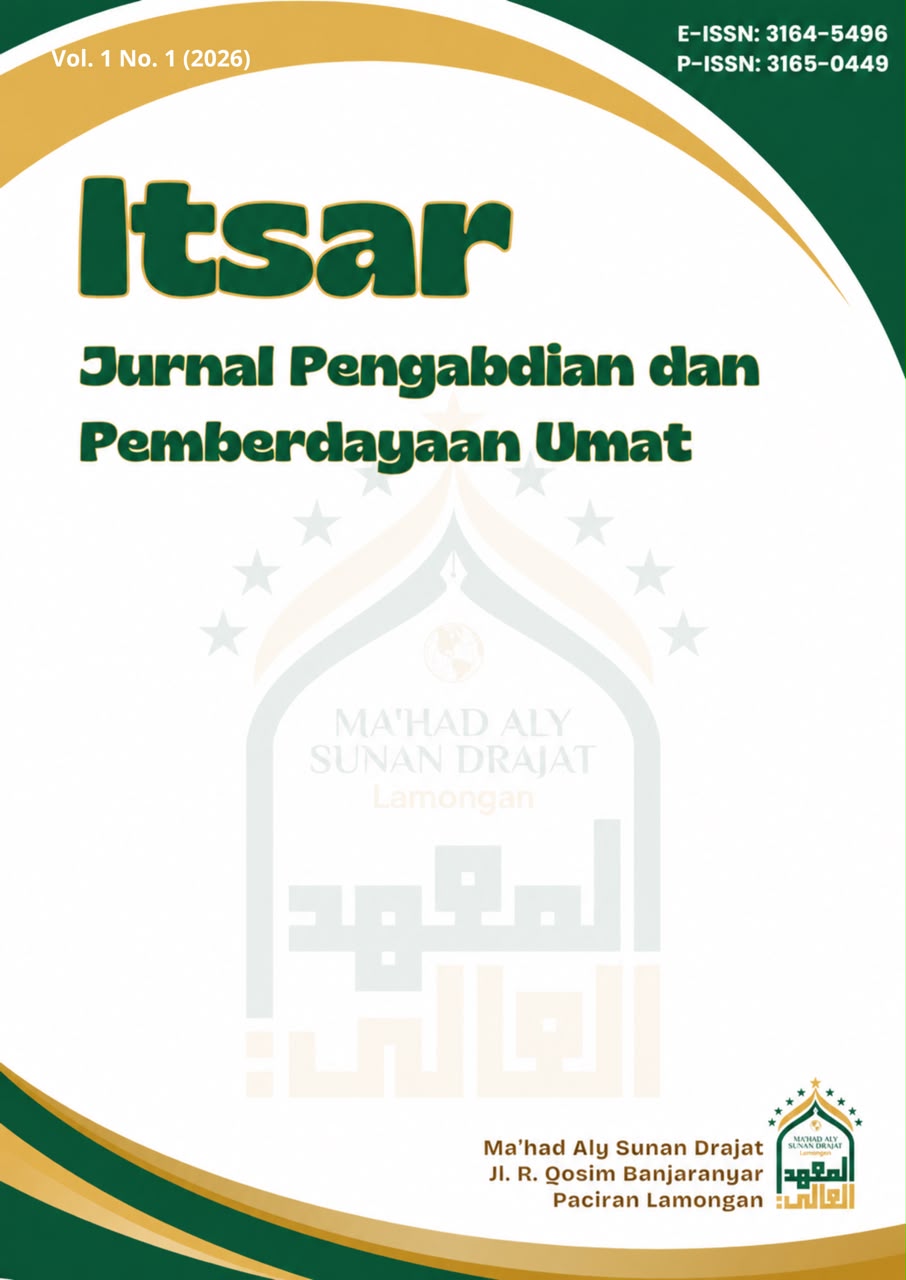
Itsar: Jurnal Pengabdian dan Pemberdayaan Umat in its June 2026 issue presents community service and empowerment reports from authors, scholars and practitioners across three countries: Indonesia, Malaysia, and Thailand. As a scientific medium dedicated to service works grounded in Islamic values, this issue highlights practical efforts in pesantren-based empowerment, educational capacity building, religious literacy, and institutional strengthening, all oriented toward the realization of community maslahah (public good).
The published articles examine a diverse range of service-oriented themes, including: a training program on the uṣūl al-fiqh rules of al-‘Ām and its takhṣīṣ to improve the istinbāṭ al-aḥkām ability of sixth-grade students at MMA Sunan Drajat; the strategic implementation of religious moderation through tarbiyah value application at Sunan Drajat Islamic Boarding School as a means of fostering social harmony; a critical analysis of educational mission degradation in Malaysia's Era 4.0, integrating conflict theory with Syed Naquib Al-Attas's ta'dīb framework to inform community-based educational interventions; practical fiqh assistance for female madrasah students concerning the validity of wudhu when using beauty products, addressing daily religious needs; and a reflective study on study visits as a tool for institutional capacity strengthening and the enhancement of pesantren scholarly traditions, based on the experience of Ma'had Aly Sunan Drajat to Ma'had Aly An-Nur 2 Al-Murtadho Malang.
Collectively, these contributions demonstrate the ongoing relevance of Islamic values and classical scholarship in addressing real-world community needs—from religious education and legal literacy to institutional development and social cohesion—while fostering international collaboration in the field of Islamic community service and empowerment.
Published:
2026-10-20